-
Title/Item
-
Lyman Wave Machine
-
ID#
-
PHY0366
-
Creator/ Maker
-
E S Ritchie & Sons
-
Date Created
-
19th Century
-
Location Made
-
Boston, MA
-
Materials
-
Wooden frame/base, brass
-
Location Stored
-
Sanders Physics and Asrtronomy
-
Category
-
Equipment, Models
-
Description
-
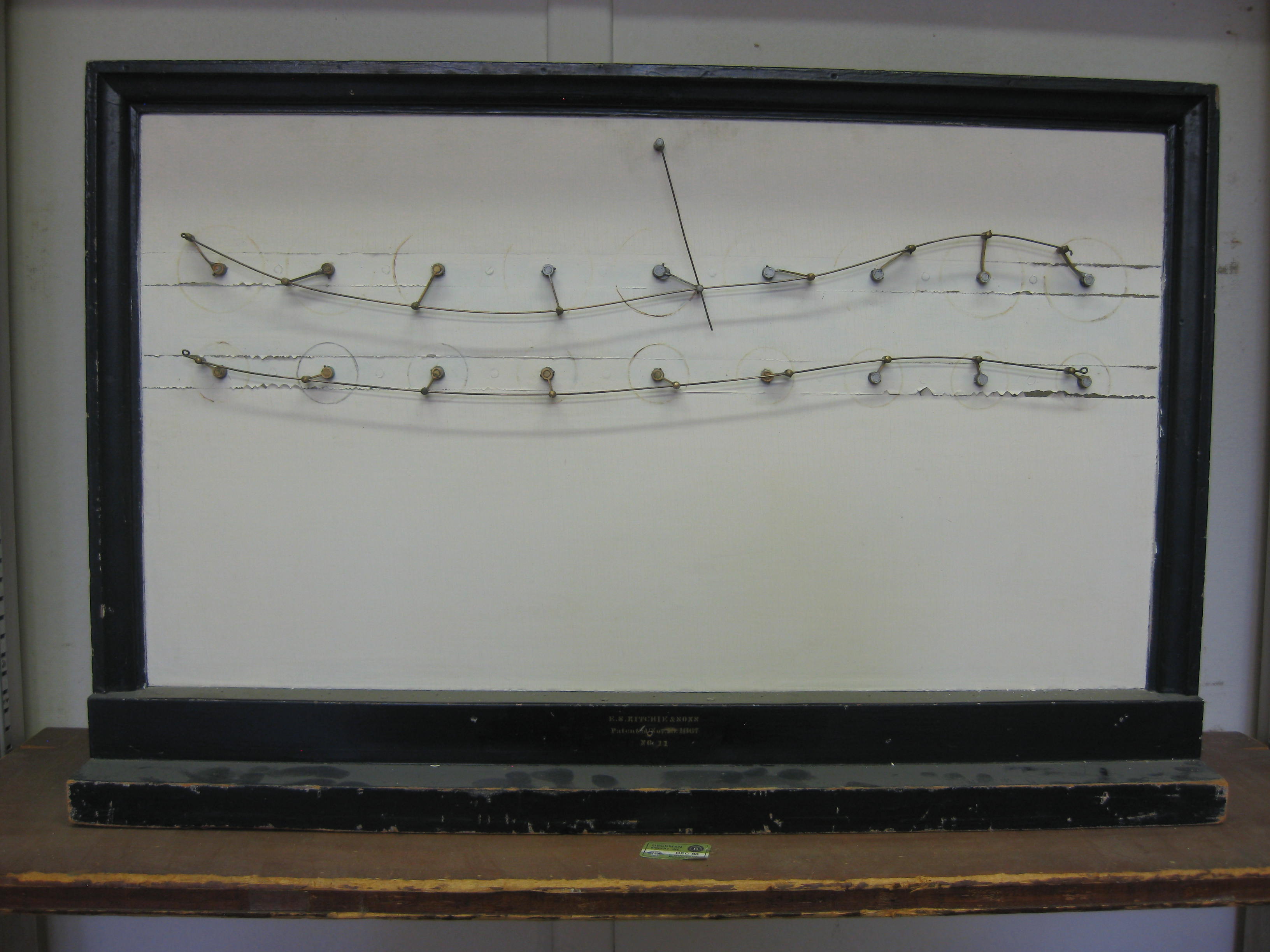
In 1868, Prof. Chester Smith Lyman, Professor of Industrial Mechanics and Physics in the Yale Scientific School, published a description of the wave machine at the left. The design had been patented by Lyman on November 19, 1867, who assigned the patent to the Boston maker of physical instruments, E. S. Ritchie.
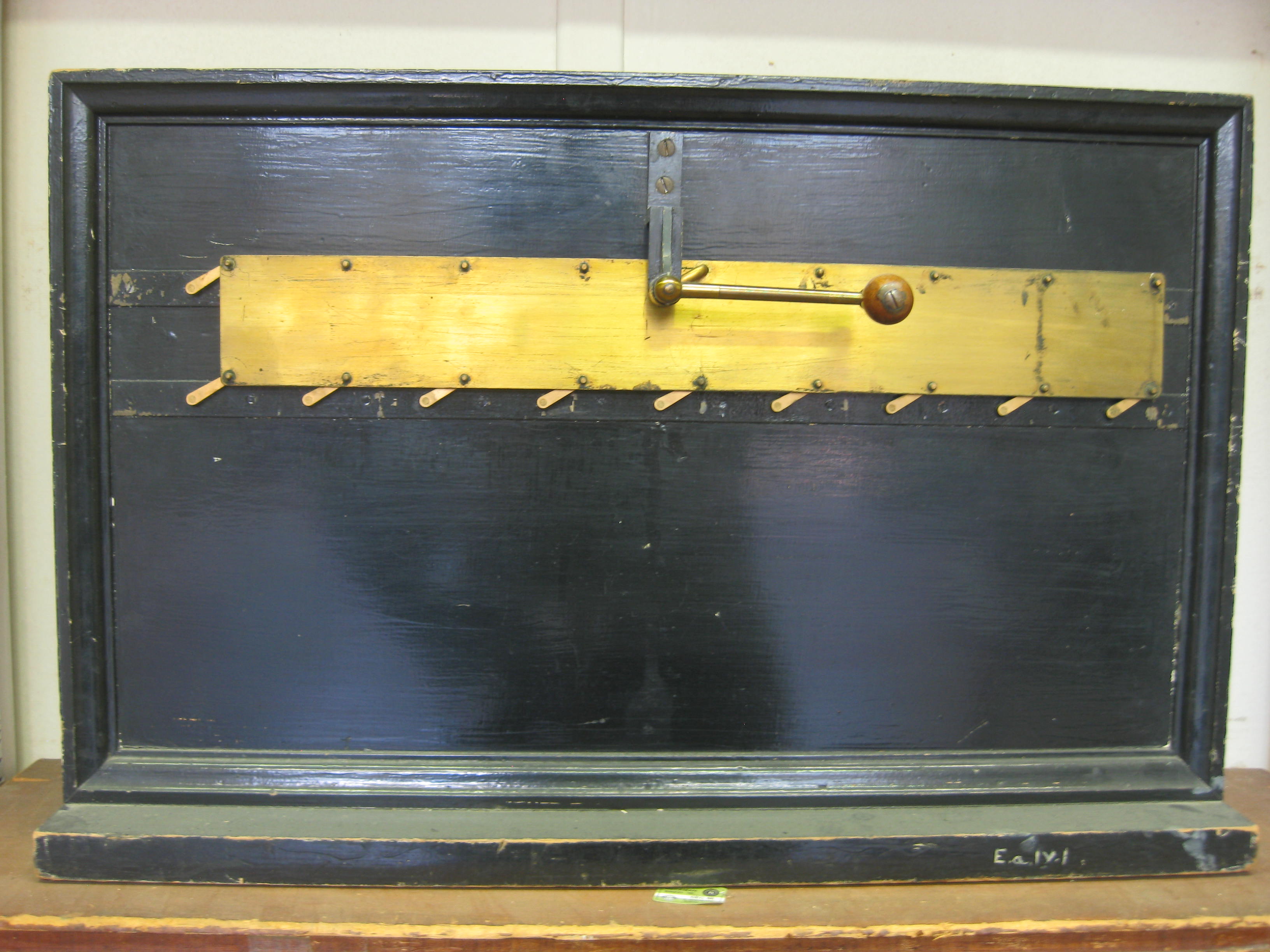
Lyman’s wave machine was designed to demonstrate the motion of water molecules during the passage of deep-water waves. Lyman reproduced the aspects of water wave motion in a simple mechanical device mounted on a board 17 in. high and 26 in. long. The ends of a series of nine cranks, revolving simultaneously and successively 45° out of phase with each other, represent water molecules. A thin, flexible wire passing through freely rotating studs at the ends of the cranks traces out the shape of the water surface. A set of shorter cranks placed on a lower level illustrate the decrease in the amplitude of the circular motion with increasing depth. The back view of the wave machine shows how a single plate connects all eighteen cranks and makes them rotate together.
Text by Thomas Greenslade, Kenyon College